
GLAN TAYLOR POLARIZER
Keywords:
Keywords:
GLAN TAYLOR POLARIZER
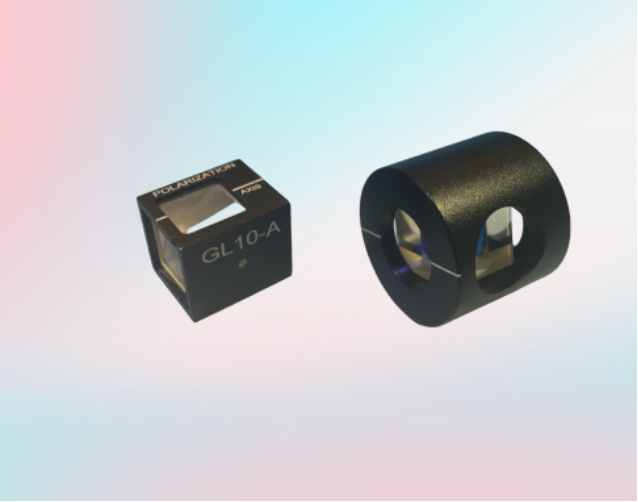
Basic Parameters
Glan Taylor Polarizercontain a variety of materials, including Calcite crystals, A-BBO crystals, YVO4 crystals, . Glan Taylor Polarizer are compact and shorter in length than Glan Laser Polarizer, making them suitable for high polarization applications at low to medium power. It can make the input unpolarized beam into a pure polarized light, and is often used as a bias or bias detector for optical path systems.
The Glan-Taylor Polarizer is a high-performance optical component widely used in scientific research, laser systems, and precision optical setups. It is designed to achieve high polarization purity and is suitable for applications requiring reliable and consistent control of light polarization. The Glan-Taylor Polarizer can convert an unpolarized input beam into highly polarized light, making it a critical component in systems where accurate polarization control is essential.
These polarizers are constructed from a variety of high-quality optical materials, including Calcite crystals, A-BBO crystals, and YVO4 crystals. Each material is carefully selected to provide specific optical characteristics, including high transmittance, minimal absorption, and excellent thermal and mechanical stability. Calcite-based Glan-Taylor Polarizers are particularly noted for their exceptional birefringence and ability to achieve very high extinction ratios, making them suitable for precision laboratory measurements and laser experiments. A-BBO and YVO4 crystals are also used to extend the operational wavelength range and enhance performance in specialized applications.
Compared to Glan-Laser Polarizers, Glan-Taylor Polarizers are more compact and shorter in length, offering practical advantages in systems with space limitations. Their compact design does not compromise performance; instead, it allows for easier integration into optical setups while still maintaining high polarization purity. This makes Glan-Taylor Polarizers ideal for a wide range of applications, including polarization-sensitive imaging, optical metrology, and laser systems operating at low to medium power levels.
A key feature of the Glan-Taylor Polarizer is its ability to generate a pure polarized output from an unpolarized input beam. This is achieved through the precise alignment of birefringent crystal axes, which splits the incoming light into ordinary and extraordinary rays. The extraordinary ray is transmitted through the polarizer, while the ordinary ray is internally reflected and absorbed, resulting in highly polarized output light. The high extinction ratio and low beam deviation provided by the Glan-Taylor design ensure that the output beam is clean and well-defined, suitable for sensitive optical measurements.
In addition to its use as a standalone polarizer, the Glan-Taylor Polarizer is frequently employed as a bias or bias detector in optical path systems. By controlling the polarization state of light within the system, it helps optimize the performance of downstream components such as modulators, waveplates, and interferometers. Its precise polarization control is also critical in experiments that rely on polarized light, including nonlinear optics, spectroscopy, and quantum optics research.
The Glan-Taylor Polarizer is available in multiple configurations to meet diverse application needs. Anti-reflection coatings can be applied to reduce surface reflections and improve transmission efficiency. Mounting options allow easy alignment and adjustment in complex optical setups, and the polarizer can be used across a wide spectral range depending on the chosen crystal material. Its robust construction ensures long-term stability and repeatable performance even in demanding laboratory or industrial environments.
Overall, the Glan-Taylor Polarizer is a versatile and reliable optical component that provides high-quality polarization for a broad spectrum of scientific and industrial applications. Its combination of compact size, high polarization purity, and compatibility with various optical materials makes it a preferred choice for researchers and engineers seeking precise control of light in experimental and practical setups. Whether used for generating pure polarized beams, acting as a bias in optical systems, or enhancing the performance of lasers and imaging equipment, the Glan-Taylor Polarizer remains an essential tool in modern optics.
|
FEATURES |
|
Air -spaced design |
|
Compact structure |
|
Highly polarized output |
|
No escape window on the side |
|
Suitable for low and medium power |
|
Broadband anti-reflection film can be plated |
Processing Index
| Standard Specifications | Calcite | a-BBO/Barium Borate | YVO4/Yttrium Vanadate |
| Wavelength | 350-2000nm | 190-3500nm | 500-4000nm |
| Extinction Ratio | <5*10-5 | <5*10-6 | <5*10-6 |
| Surface Quality | 20/10 Scratch/Dig | ||
| Beam Deviation | < 3 arc minutes | ||
| TWD | <λ/4@633nm | ||
| LIDT | >200MW/cm2@1064nm, 20ns, 20Hz | ||
| Coating | P Coating,Customizable coating available per customer requirements | ||
| Mounting |
Anodized Aluminum Mount Square or round mount available |
||
a-BBO Standard Products:
| Type | Wavelength | Extinction Ratio | Angle | CA | Square Mount (mm) | Round Mount (mm) |
| GTP1206 | 200-300nm | <5*10-6 | >6° | φ6.0 | 9*9*8 | φ15*15 |
| GTP1210 | φ10 | 13*13*11 | φ25.4*19 | |||
| GTP1215 | φ15 | 18*18*16 | φ30*23 | |||
| GTP1220 | φ20 | 24*24*20 | φ38*29 | |||
| GTP1306 | 300-700nm | <5*10-6 | >6° | φ6.0 | 9*9*8 | φ15*15 |
| GTP1310 | φ10 | 13*13*11 | φ25.4*19 | |||
| GTP1315 | φ15 | 18*18*16 | φ30*23 | |||
| GTP1320 | φ20 | 24*24*20 | φ38*29 | |||
| GTP1706 | 700-3500nm | <5*10-6 | >6° | φ6.0 | 9*9*8 | φ15*15 |
| GTP1710 | φ10 | 13*13*11 | φ25.4*19 | |||
| GTP1715 | φ15 | 18*18*16 | φ30*23 | |||
| GTP1720 | φ20 | 24*24*20 | φ38*29 |
Calcite Standard Products:
| Type | Wavelength | Extinction Ratio | Angle | CA | Square Mount (mm) | Round Mount (mm) |
| GTP2006 | 350-2300nm | <5*10-5 | >6° | φ6.0 | 9*9*8 | φ15*15 |
| GTP2010 | φ10 | 13*13*11 | φ25.4*19 | |||
| GTP2015 | φ15 | 18*18*16 | φ30*23 | |||
| GTP2020 | φ20 | 24*24*20 | φ38*29 |
YVO4 Standard Products:
| Type | Wavelength | Extinction Ratio | Angle | CA (mm) |
Square Mount (mm) |
Round Mount (mm) |
| GTP3006 | 500-4000nm | <5*10-6 | >6° | φ6.0 | 9*9*8 | φ15*15 |
| GTP3010 | φ10 | 13*13*11 | φ25.4*19 | |||
| GTP3015 | φ15 | 18*18*16 | φ30*23 | |||
| GTP3020 | φ20 | 24*24*20 | φ38*29 |
Solutions

Scientific research and testing field

Aviation field

Medical cosmetology field
Laser field
Related Products

YVO4
Yttrium alumate (YVO4) is an excellent birefringent crystal material, which is a negative uniaxial crystal. The crystal has good physical and mechanical properties, wide light transmission range, high transmittance, large birefringence coefficient and easy processing. YVO4 crystal can replace ice SPAR and crystal red stone in the field of optical fiber communication, is the key material in optical communication passive devices such as optical isolators, circulators, polarization splitters, polarizers.
Caicite
Caicite Crystal is a kind of natural birefringent material, in the shape of diamond, birefringence coefficient is large, through the spectrum is wide, from visible to near infrared has relatively good optical properties. Although the mechanical strength of Iceland SPAR material is soft and easy to scratch, it still does not affect its wide application in polarization devices. Caicite is mainly used in Glan POLARIZER.
LiNbO3
LiNbO3 is widely used in optical fiber communication as a birefringent crystal. The crystal has good physical and mechanical properties, wide light transmission range, high transmittance, easy processing, and lower material cost than other materials. Lithium niobate crystals are widely used in passive optical communication devices such as optical isolators, circulators, polarization splitters, polarizers, etc
POLARIZING BEAM SPLITTER(PBS)
The polarization splitter prism is plated with a multilayer film structure on the inclined surface of the right Angle prism, and then glued into a cube structure. By taking advantage of the property that the transmission rate of P-polarized light is 1 and that of S-polarized light is less than 1 when the light incident at Brewster Angle, the P polarization component can be completely penetrated after the light passes through the multilayer film structure at Brewster Angle for many times. And most of the S polarization component is reflected. Note: Specific bands and extinction ratios can be customized according to customer requirements.
Product Inquiry
*Note: Please be sure to fill in the information accurately and keep the communication open. We will contact you as soon as possible.
